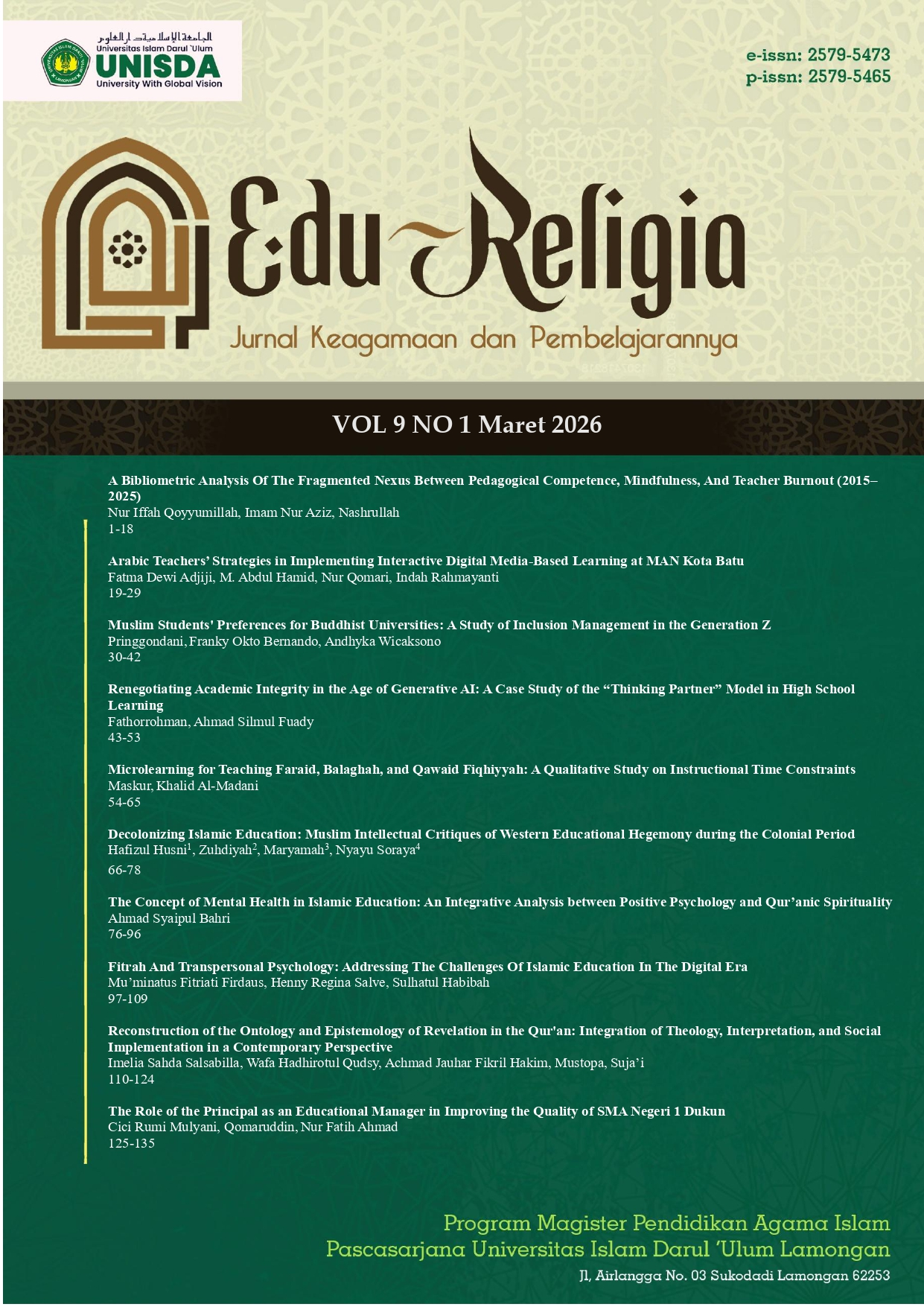
Fitrah And Transpersonal Psychology: Addressing The Challenges Of Islamic Education In The Digital Era
Keywords:
Fitrah, Transpersonal Psychology, Islamic education, Digital eraAbstract
The rapid development of digital technology has brought various challenges, such as fragmented attention, digital social pressure, and identity struggles related to the meaning of life, resulting in changes to students’ psychological and social environments. These dynamics, within the context of Islamic education, require an approach that addresses not only students’ cognitive development but also their spiritual dimensions and consciousness. This article examines the integration of the concept of fitrah in Islam and transpersonal psychology as a conceptual framework to address contemporary challenges in Islamic education during the digital era. This study used a systematic literature review approach, examining relevant studies on fitrah, transpersonal psychology, fitrah and transpersonal psychology, and digital era. These findings yield a conceptual model of integration between Fitrah and Transpersonal Psychology to address the challenges of the digital era within the context of Islamic education, comprising the digital context, fitrah, self-awareness, transpersonal consciousness, meaning-making, human transformation, and holistic Islamic education. Education in Islam is understood as a holistic process of human transformation, grounded in fitrah and transpersonal consciousness, thereby fostering students' ability to address the challenges of digitalization.
Downloads
References
Abd Rahman, N., Zabidi, F. N. M., & Halim, L. (2020). Integration of Tauhidic Elements for Environmental Education from the Teachers’ Perspectives. Religions, 11(8), 394. https://doi.org/10.3390/rel11080394
Aisyah, S. (2025). Integrasi Pendidikan Islam dalam Membangun Kepribadian Muslim yang Tangguh dalam Menghadapi Tantangan Zaman. Al-Ilmi : Journal of Islamic Education, 2(2), 113-139.
Amaliati, S., Mudhlofir, A., & Fitriani, E. (2024). Realitas Konsep Pendidikan Humanisme Dalam Konteks Pendidikan Islam. Indonesian Journal of Humanities and Social Sciences, 5(1), 267–281. https://doi.org/https://doi.org/10.33367/ijhass.v5i1.4643
Arroisi, Jamal, & Al-Fikry. (2021). Fitrah According to The Qur’an: Personality Analysis of Islamic Psychology Perspective. Dialogia, 19(1), 105–135. https://jurnal.iainponorogo.ac.id/index.php/dialogia/article/view/2405
Banerji, D. (2023). Western Buddhism and Transpersonal Psychology: Cross-Hermeneutic and Engaged Approaches. International Journal of Transpersonal Studies, 42(2), 27–34. https://doi.org/10.24972/ijts.2023.42.2.27
Bor, A., & Şahin, H. (2018). The Nature of Disposition (Fiṭrah) in Relation with Religion. Cumhuriyet İlahiyat Dergisi, 22(3), 1765–1788. https://doi.org/10.18505/cuid.448089
Daniels, M., Sharma, M., & Batra, K. (2021). Social media, stress and sleep deprivation: A triple “S” among adolescents. Journal of Health and Social Sciences, 6(2), 159–166. https://doi.org/10.19204/2021/sclm3
Hancock, J., Liu, S. X., Luo, M., & Mieczkowski, H. (2022). Psychological Well-Being and Social Media Use: A Meta-Analysis of Associations between Social Media Use and Depression, Anxiety, Loneliness, Eudaimonic, Hedonic and Social Well-Being. SSRN Electronic Journal. https://doi.org/10.2139/ssrn.4053961
Hanief, I., Sawaliyah, S. J., & Mahwiyah. (2023). The Concept of Fitrah and the Implications of Islamic Education. Amandemen: Journal of Learning, Teaching and Educational Studies, 1(1), 1–6. https://doi.org/10.61166/amd.v1i1.1
Hartelius, G. (2016). Transpersonal is a Whole Person Psychology (Editor’s Introduction). International Journal of Transpersonal Studies, 35(2), iii–vi. https://doi.org/10.24972/ijts.2016.35.2.iii
Hartelius, G. (2022). What is transpersonal psychology? A concise definition based on 20 years of research. The International Journal of Transpersonal Studies, 41(1), 5–19. https://doi.org/10.24972/ijts.2022.41.1.5
Haryanto, S., & Muslih, M. (2025). The Contribution of Transpersonal Psychology to The Emotional, Mental, and Spiritual Well-Being of Individuals. Islamic Guidance and Counseling Journal, 8(1). https://doi.org/10.25217/0020258549000
Haryanto, S., & Sila, H. B. D. (2022). Integration and Interconnection of Human Concepts in Islamic and Transpersonal Psychology. International Journal of Islamic Educational Psychology, 3(1). https://doi.org/10.18196/ijiep.v3i1.14593
Husain, A., Nazam, F., & Gull, M. (2024). Reliability, Validity and Factor Structure of Fitrah Scale. Afkar: Jurnal Akidah Dan Pemikiran Islam, 26(2)(2), 235–254. https://doi.org/10.22452/afkar
Ismail, H. W., & Berghout, A. (2024). Rethinking the Concept of Al-Saadah (Happiness) in Light of the Quranic Istikhlaf Framework. Journal of Islam in Asia, 21(1), 277–305. https://doi.org/10.31436/jia.v21i1.1219
Keles, B., McCrae, N., & Grealish, A. (2020). A systematic review: the influence of social media on depression, anxiety and psychological distress in adolescents. In International Journal of Adolescence and Youth (Vol. 25, Number 1, pp. 79–93). Routledge. https://doi.org/10.1080/02673843.2019.1590851
Maslow, A. H. (1969). The Farther Reaches of Human Nature. Journal of Transpersonal Psychology, 1(1), 1–9. www.HumanPotentialCenter.org
McCrory, A., Best, P., & Maddock, A. (2020). The relationship between highly visual social media and young people’s mental health: A scoping review. Children and Youth Services Review, 115. https://doi.org/10.1016/j.childyouth.2020.105053
Mohamed, Y. (1995). Fitrah and Its Bearing on the Principles of Psychology. American Journal of Islam and Society, 12(1), 1–18. https://doi.org/10.35632/ajis.v12i1.2402
Muniroh, M. (2019). Fitrah Based Education: Implementasi Manajemen Pendidikan Berbasis Fitrah di TK Adzkia Banjarnegara. In Jurnal Manajemen Pendidikan Islam (Vol. 4, Number 2).
Hamidy, B. N., & Sassi, K. (2025). Konsep Fitrah Manusia Dan Implikasinya Dalam Dunia Pendidikan. INNOVASI : Jurnal Inovasi Pendidikan, 11(2), 83–92. https://doi.org/10.64540/innovasi62
Nuranisa, L., Anwar, S., & Iman Firmansyah, M. (2025). Fitrah-Based Islamic Education: A Study Of The Concept Of Fitrah-Based Education By Harry Santosa. Jurnal Cendekia : Media Komunikasi Penelitian Dan Pengembangan Pendidikan Islam, 17(1), 87–02. https://doi.org/doi.org/10.37850/cendekia
Odgers, C. L., & Jensen, M. R. (2020). Annual Research Review: Adolescent mental health in the digital age: facts, fears, and future directions. In Journal of Child Psychology and Psychiatry and Allied Disciplines (Vol. 61, Number 3, pp. 336–348). Blackwell Publishing Ltd. https://doi.org/10.1111/jcpp.13190
Pransiska, T., Sunan, U., & Yogyakarta, K. (2016). Konsepsi Fitrah Manusia Dalam Perspektif Islam Dan Implikasinya Dalam Pendidikan Islam Kontemporer. In Jurnal Ilmiah DIDAKTIKA Agustus (Vol. 17, Number 1).
Rimban, E., Coloma, M. A., Camaeg, J., & Payaket, M. (2024). Unifying Perspectives Through Transpersonal Psychology. SSRN 4767137. https://doi.org/10.2139/ssrn.4767137
Rini, T. P., & Masduki, M. (2020). Pendidikan Karakter Keluarga Di Era Digital. In Indonesian Journal of Islamic Studies and Humanities (Vol. 1, Number 1).
Ryff, C. D., Boylan, J. M., & Kirsch, J. A. (2021). Eudaimonic and hedonic well-being: An integrative perspective with linkages to sociodemographic factors and health. In M. T. Lee, L. D. Kubzansky, & T. J. VanderWeele (Eds.), Measuring Well-Being: Interdisciplinary Perspectives from the Social Sciences and the Humanities (pp. 92–135). Oxford University Press. https://doi.org/10.1093/oso/9780197512531.003.0005
Shapiro, S. I., Lee, G. W., & Gross, P. L. (2002). The Essence of Transpersonal Psychology Contemporary Views. International Journal of Transpersonal Studies, 21(1), 19–32. https://doi.org/10.24972/ijts.2002.21.1.19
Sit, M., Ramzani, O. D., Rahmi, M. A., & Sapiyah, J. (2025). Konsep Fitrah dalam Tafsir Al Misbah. Edu Society: Jurnal Pendidikan, Ilmu Sosial Dan Pengabdian Kepada Masyarakat, 5(3), 1057–1065. https://doi.org/10.56832/edu.v5i3.2239
Sutikno, M. S., & Hadisaputra, P. (2021). Penelitian Kualitatif. Lombok: Holistica.
Ulfiani, D. Y., Azani, M. Z., & Jamuin, M. (2022). Convergence Theory in Islamic Perspective (Study of Fitrah Education in Qs. Ar-Rūm Verse 30). In International Conference on Islamic and Muhammadiyah Studies (ICIMS), 253–258. https://doi.org/10.2991/assehr.k.220708.032
Widyasari, V., Prabandari, Y. S., & Utarini, A. (2020). Training intervention to improve hygiene practices in Islamic boarding school in Yogyakarta, Indonesia: A mixed-method study. PLoS ONE, 15(5). https://doi.org/10.1371/journal.pone.0233267
Zarkasyi, H. F. (2020). Minhaj: Berislam dari Ritual hingga Intelektual. Jakarta Selatan: Institute for the Study of Islamic Thought and Civilizations (INSISTS).
Zhang, Q. (2025). The interplay of technology, family, and identity: Chinese adolescents’ self-presentation on Douyin. Frontiers in Psychology, 16, 1–8. https://doi.org/10.3389/fpsyg.2025.1544224
Downloads
Published
How to Cite
Issue
Section
License
Copyright (c) 2026 EDU-RELIGIA : Jurnal Keagamaan dan Pembelajarannya

This work is licensed under a Creative Commons Attribution-ShareAlike 4.0 International License.