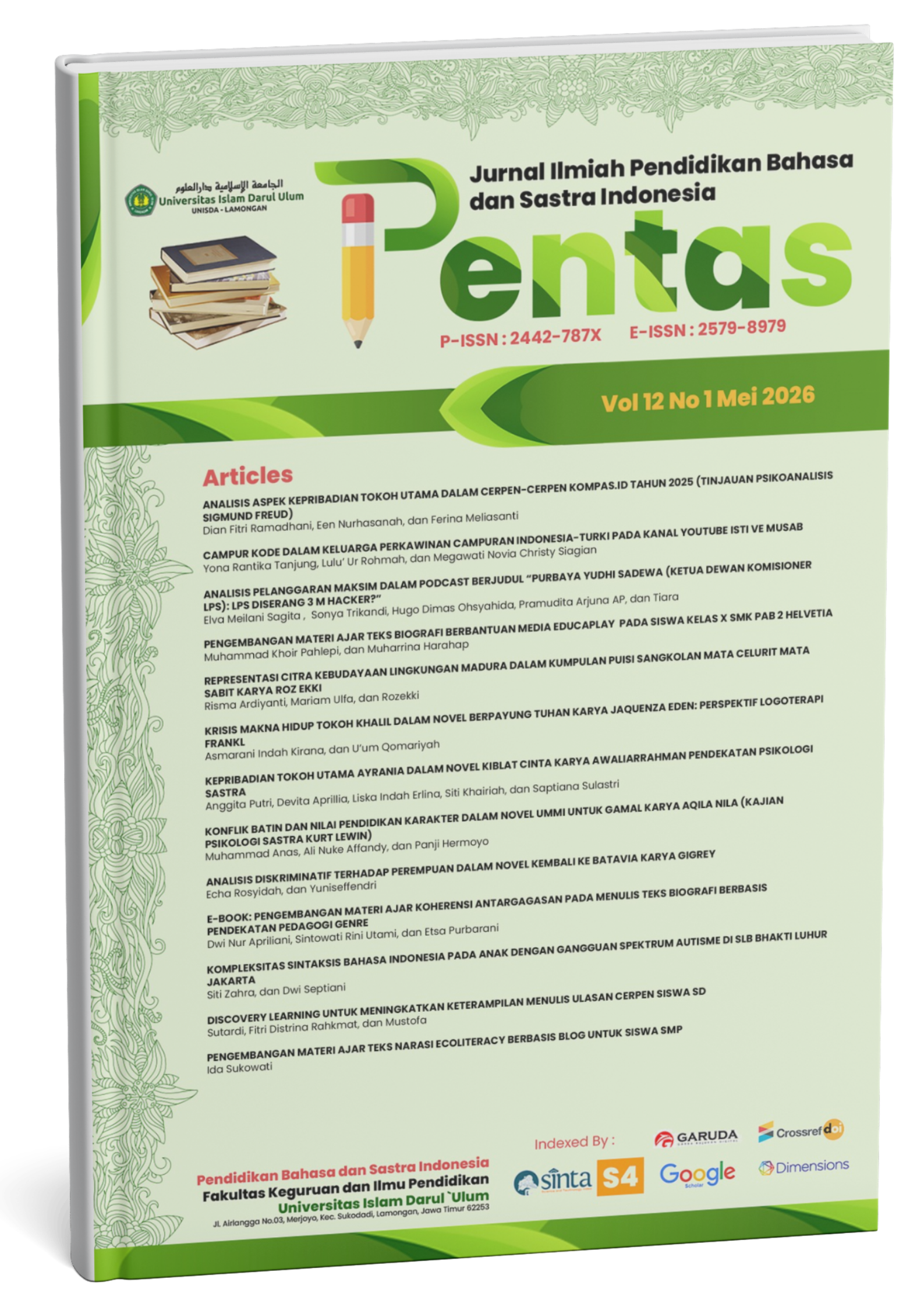
KEPRIBADIAN TOKOH UTAMA AYRANIA DALAM NOVEL KIBLAT CINTA KARYA AWALIARRAHMAN PENDEKATAN PSIKOLOGI SASTRA
DOI:
https://doi.org/10.52166/pentas.v12i1.12679Kata Kunci:
Psikologi Sastra, Psikoanalisis Sigmund Freud, Struktur Kepribadian, Novel Kiblat Cinta, Tokoh AyraniaAbstrak
Penelitian ini bertujuan mendeskripsikan struktur kepribadian tokoh utama Ayrania dalam novel Kiblat Cinta karya Awaliarrahman melalui pendekatan psikologi sastra, khususnya pemanfaatan teori psikoanalisis Sigmund Freud. Metode yang digunakan adalah kualitatif deskriptif analitis, dengan teknik pengumpulan data berupa studi pustaka melalui metode baca dan catat dari korpus teks novel. Hasil analisis menunjukkan bahwa kepribadian Ayrania dibentuk oleh dinamika yang kompleks antara id, ego, dan superego. Aspek id ditandai oleh dorongan impulsif, emosional, dan keinginan pemenuhan kepuasan secara instan. Aspek ego beroperasi berdasarkan prinsip realitas untuk meredam dorongan id agar selaras dengan kondisi lingkungan, terlihat dari perilaku santun dan pengendalian amarah. Sementara itu, superego bertindak sebagai kompas moral yang mendikte kepatuhan tokoh terhadap norma sosial, etika, dan tanggung jawab.
Unduhan
Referensi
Amalia, D., Hadi, S. R., & Wulandari, E. (2025). Hasrat Kepribadian Tokoh Utama Dalam Cerpen Samurai Karya Kuntowijoyo: Kajian Psikoanalisis Jacques Lacan. SeBaSa, 8(1), 311–329. https://doi.org/10.29408/sbs.v8i1.29054
Arafah, B. (2023). Emotional Management of Defoe ’ s Robinson Crusoe ’ s Main Character. 14(5), 1414–1421
Güler, G. B. (2025). Envy and Jealousy in Nina Berberova’s The Accompanist through the Prism of Personality Emotion Theory. Quaestio Rossica, 13(1), 193–210. https://doi.org/10.15826/qr.2025.1.961
Jurkovac, M. (2024). Prikaz žena i prikaz ljubavnih odnosa u romanu Ne traži me u sebi Ane Žube . Kroatologija, 15(2), 31–50. https://doi.org/10.59323/k.15.2.2
Mardarika, A. (2023). Analisis struktur kepribadian tokoh utama dalam novel Seaside karya Zee [Doctoral dissertation, Universitas Muhammadiyah Mataram].
Minderop, A. (2016). Psikologi sastra: Karya sastra, metode, teori, dan contoh kasus. Yayasan Pustaka Obor Indonesia.
Moleong, L. J. (2000). Metodologi penelitian kualitatif. PT Remaja Rosdakarya.
Nurgiyantoro, B. (1995). Teori pengkajian fiksi. Gadjah Mada University Press.
Pratama Andika, 2018. Strukturalisme genetik pada novel asmaraloka karya danarto . Skripsi. (2018). 2, 2018.
Pratama, A. (2019). Strukturalisme genetik pada novel Asmaraloka karya Danarto [Skripsi, Universitas Muhammadiyah Makassar].
Puspitasari, P. D. W. (2016). Kepribadian tokoh utama Viktor Larenz dalam roman Die Therapie karya Sebastian Fitzek: Teori psikoanalisis Freud [Skripsi, Universitas Negeri Yogyakarta].
Ratnasari, D. (2020). Analisis kepribadian tokoh utama novel Merindu Baginda Nabi karya Habiburrahman El Shirazy: Kajian psikologi sastra [Doctoral dissertation].
Sastra, P. (2026). Ketidakmatangan psikologis tokoh lana dan reno dalam novel dream partner karya nda quilla: analisis psikologi sastra 1. 91–102.
Serafina, S. P. (2022). Kepribadian tokoh utama dalam novel My Lecturer My Husband karya Gitlicious (Pendekatan psikologi sastra) [Doctoral dissertation, IKIP PGRI Pontianak].
Siswantoro. (2020). Metode penelitian sastra. Pustaka Pelajar.
Suryabrata, S. (2015). Psikologi kepribadian. Rajawali Pers.
Umamy, E., Supratno, H., & Indarti, T. (2025). Paradoxical symbolism in Madurese fiction: A psychoanalytic perspective. Edelweiss Applied Science and Technology, 9(4), 1614–1625. https://doi.org/10.55214/25768484.v9i4.6348
Wulandari, A. (2013). Perwatakan tokoh utama dalam novel Cintrong Paju-Pat karya Suparto Brata; Sebuah kajian psikologi sastra [Skripsi, Universitas Negeri Yogyakarta].
Yang, B., & Netthanyakonwong, A. (2024). Phloi from mirror image to death by madness: A Lacanian reading of Kukrit Pramoj ’s “Four Reigns.” Kasetsart Journal of Social Sciences, 45(1), 305–312. https://doi.org/10.34044/j.kjss.2024.45.1.31
Zaimi, B., & Kushta, E. (2025). Concealing and Revealing: Repression in a Pale View of Hills and the Remains of the Day. Filolog (Banja Luka), 16(31), 479–500. https://doi.org/10.21618/fil2531479z
Unduhan
Diterbitkan
Cara Mengutip
Terbitan
Bagian
Lisensi
Hak Cipta (c) 2026 PENTAS : Jurnal Ilmiah Pendidikan Bahasa dan Sastra Indonesia

Artikel ini berlisensiCreative Commons Attribution-ShareAlike 4.0 International License.
Authors who publish with PENTAS agree to the following terms:
Authors retain copyright and grant the Engagement right of first publication with the work simultaneously licensed under a Creative Commons Attribution License (CC BY-SA 4.0) that allows others to share (copy and redistribute the material in any medium or format) and adapt (remix, transform, and build upon the material) the work for any purpose, even commercially with an acknowledgement of the work's authorship and initial publication in PENTAS .
Authors are able to enter into separate, additional contractual arrangements for the non-exclusive distribution of the journal's published version of the work (e.g., post it to an institutional repository or publish it in a book), with an acknowledgement of its initial publication in PENTAS .
Authors are permitted and encouraged to post their work online (e.g., in institutional repositories or on their website) prior to and during the submission process, as it can lead to productive exchanges, as well as earlier and greater citation of published work (See The Effect of Open Access).
This work is licensed under a Creative Commons Attribution-ShareAlike 4.0 International License.